
In a decisive move to deepen credit access for India’s micro, small and medium enterprises, the Union Cabinet’s approval of a ₹5,000 crore equity infusion into the Small Industries Development Bank of India marks one of the most significant policy interventions for the MSME sector in recent years. The capital support, to be provided in a phased manner over three financial years, is expected to fundamentally reshape how small businesses—particularly first-time and asset-light enterprises—access formal finance in the country.
At the heart of this decision lies a clear policy objective. India’s MSME sector, which employs over 30 crore people and contributes significantly to GDP and exports, continues to face a persistent credit gap. Traditional banking systems have often struggled to serve small entrepreneurs who lack collateral, formal credit histories, or long operating track records. By strengthening SIDBI’s capital base, the government aims to address this structural issue through expanded digital and collateral-free lending.
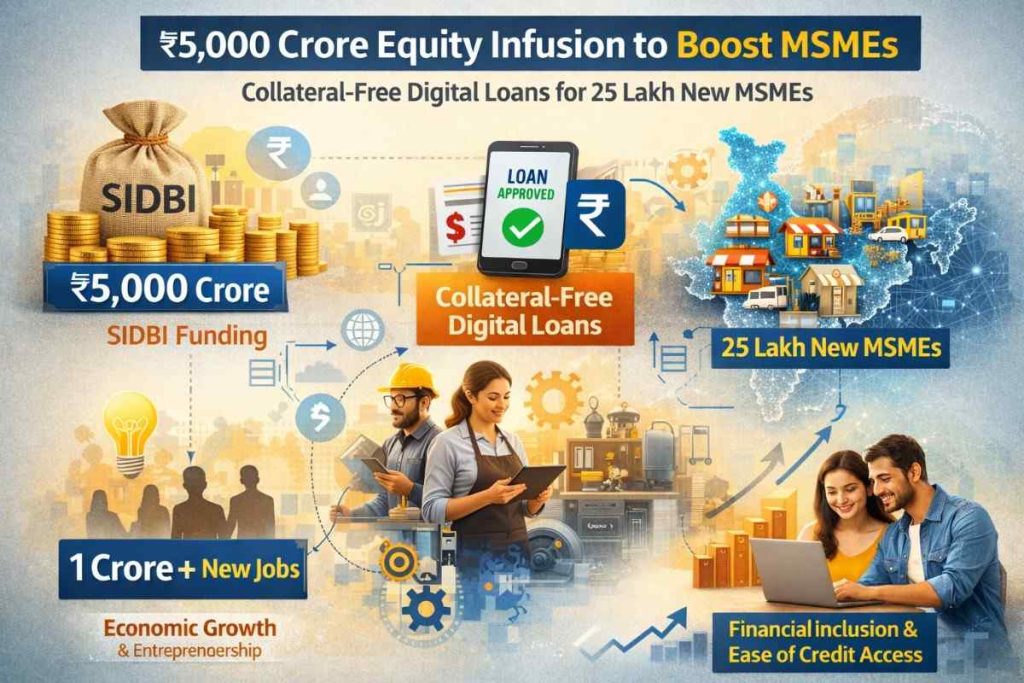
SIDBI, established as the apex development finance institution for MSMEs, plays a dual role in the ecosystem. It lends directly to enterprises while also refinancing banks, non-banking financial companies and fintech lenders that cater to small businesses. The ₹5,000 crore equity infusion enhances SIDBI’s ability to take on higher-risk portfolios, lower borrowing costs, and scale innovative credit products without compromising capital adequacy norms. Officials indicate that the additional capital will allow SIDBI to support approximately 25 lakh new MSMEs by the end of FY 2027–28, bringing a large segment of informal businesses into the formal financial system.
The timing of the infusion is critical. As global economic conditions remain uncertain and private capital becomes more selective, domestic policy-driven credit flows are emerging as a stabilising force. With stronger equity backing, SIDBI is expected to expand its balance sheet substantially, enabling higher disbursements to MSMEs across manufacturing, services, agri-based industries and emerging digital enterprises. The focus is not merely on volume but on widening access to underserved segments, including women-led businesses, rural enterprises and first-generation entrepreneurs.
A key feature of SIDBI’s expanded mandate following the infusion is the acceleration of digital, collateral-free lending. Over the past few years, advances in digital public infrastructure—such as Aadhaar-based KYC, GST data, account aggregators and real-time payment systems—have transformed credit assessment in India. SIDBI is increasingly leveraging these systems to enable faster loan approvals, paperless onboarding and risk assessment based on cash flows rather than physical assets. With enhanced capital, the bank can scale such models nationwide.
Collateral-free loans, long seen as risky by traditional lenders, are becoming viable due to improved data analytics and credit guarantee mechanisms. SIDBI’s stronger equity position allows it to absorb higher initial risk while supporting guarantee-backed products and co-lending arrangements with regulated lenders and fintech platforms. This approach significantly lowers entry barriers for new MSMEs that previously relied on informal credit at high interest rates.
The economic implications of bringing 25 lakh additional MSMEs into the formal credit system are substantial. Based on current employment patterns in the sector, policymakers estimate that this expansion could translate into more than one crore new jobs over the medium term. Beyond employment, formal credit access improves productivity, enables technology adoption and enhances resilience during economic shocks. For small businesses, institutional finance often marks the difference between survival and sustainable growth.
Industry stakeholders view the equity infusion as a long-term investment rather than a short-term stimulus. By reinforcing SIDBI’s capital structure, the government is enabling the institution to raise funds at more competitive rates from the market and pass on these benefits to MSME borrowers. This is particularly important as interest rate volatility and tighter liquidity conditions globally place pressure on small enterprises’ cost structures.
However, the expansion of digital and collateral-free lending also brings challenges. Higher exposure to new and untested borrowers increases risk-weighted assets, requiring robust credit monitoring and risk management systems. The phased nature of the equity infusion is designed to ensure that SIDBI’s capital adequacy remains well above regulatory requirements even as its loan book grows. Strengthening institutional capacity, upgrading technology systems and enhancing last-mile outreach will be crucial to ensure that credit expansion remains sustainable.
For MSMEs on the ground, the policy shift translates into tangible opportunities. Formal registration, digital compliance and transparent financial records are becoming increasingly important for accessing SIDBI-supported credit. Enterprises that adapt to digital systems and maintain clean transaction histories are likely to benefit the most from the new lending environment. As SIDBI expands partnerships with banks, NBFCs and fintech players, access points for small businesses are expected to multiply across urban and rural markets.
The ₹5,000 crore equity infusion into SIDBI signals a broader rethinking of MSME finance in India. Rather than relying solely on subsidies or short-term relief measures, the government is strengthening financial institutions to deliver long-term, scalable solutions. If executed effectively, the initiative could redefine how millions of small businesses access credit, transition into the formal economy and contribute to India’s growth story.
As the rollout progresses over the next three years, the real test will lie in execution—ensuring that capital translates into affordable, timely and inclusive credit. For India’s MSMEs, the infusion represents not just additional funds, but a structural shift towards a more accessible, digital and entrepreneur-friendly financial system.
Add startupchronicle.in as preferred source on google – Click Here
Last Updated on Thursday, January 29, 2026 8:24 am by Startup Chronicle Team
About The Author
