
As central banks across the world recalibrate interest rates in response to inflationary pressures, slowing growth, and financial stability concerns, the effects are being felt far beyond public markets. One of the more understated but significant consequences of global interest rate shifts is their impact on the availability and structure of venture debt within domestic startup ecosystems. Once seen as a niche, supplementary financing option, venture debt has become an important pillar of startup funding, particularly during periods when equity capital becomes cautious. Today, its fortunes are closely tied to the direction of global monetary policy.
Venture debt occupies a distinct position in the financing hierarchy. It is typically extended to venture-backed startups that may not yet be profitable but have strong growth prospects, reputable equity investors, and predictable funding cycles. Unlike traditional bank loans, venture debt relies less on hard collateral and more on future equity value and business momentum. This makes it especially sensitive to macroeconomic conditions, and interest rate movements play a central role in shaping both lender behavior and borrower demand.
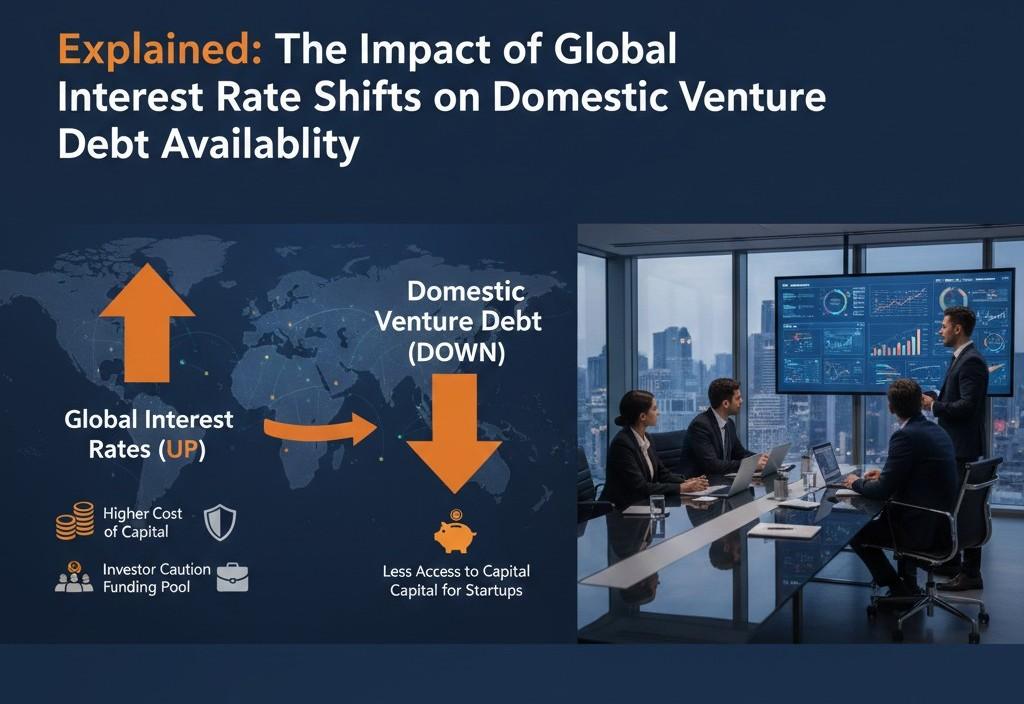
The most immediate impact of rising global interest rates is an increase in the cost of capital. When benchmark rates rise in major economies, the base funding costs for financial institutions and private credit funds increase accordingly. Venture debt lenders, many of whom raise capital from institutional investors or borrow from wholesale markets, face higher costs to deploy capital. These higher costs are passed on to startups in the form of increased interest rates, higher fees, and more conservative loan structures. For early-stage companies operating with limited cash buffers, this can materially affect runway planning and growth decisions.
Beyond pricing, global interest rate shifts influence the overall supply of venture debt by reshaping investor risk appetite. Higher interest rates raise the returns available on relatively safe assets such as government securities and high-grade corporate bonds. As these instruments become more attractive, some investors reduce exposure to higher-risk private credit strategies, including venture debt. This reallocation of capital can shrink the pool of funds available to venture lenders, particularly those focused on early-stage or pre-revenue companies.
Liquidity conditions also play a crucial role. Periods of global monetary tightening often coincide with reduced liquidity across financial markets. When liquidity tightens, lenders become more selective, prioritizing capital preservation over aggressive growth. In the venture debt market, this typically translates into stricter eligibility criteria, lower loan-to-value ratios, and a preference for startups with strong revenue visibility, shorter paths to profitability, or existing cash flows. Companies that would have easily accessed venture debt during low-rate environments may find themselves excluded when rates rise and liquidity contracts.
The impact of global interest rate shifts is further amplified through cross-border capital flows. Venture debt markets in many countries rely, directly or indirectly, on international capital. When interest rates rise sharply in developed markets, global investors often pull capital back to their home jurisdictions to capture higher risk-free returns. This can reduce foreign participation in domestic venture lending markets, particularly in emerging economies. Even when domestic monetary authorities maintain accommodative policies, global conditions can limit the effectiveness of local rate cuts in improving venture debt availability.
Exchange rate dynamics add another layer of complexity. Higher global interest rates can strengthen major currencies, increasing the cost of foreign currency-denominated debt for domestic startups. This has led many venture debt providers to either reduce exposure to currency risk or reprice loans to account for potential volatility, further tightening access for borrowers.
At the ecosystem level, these macroeconomic forces are reshaping how startups use venture debt. During periods of abundant and cheap capital, venture debt was often employed to accelerate growth, fund expansion, or delay equity dilution. In a higher-rate environment, its role has become more defensive. Startups increasingly use venture debt to extend runway, manage working capital, or navigate uncertain fundraising conditions. Lenders, in turn, emphasize capital efficiency, governance, and downside protection rather than growth-at-all-costs strategies.
Despite these headwinds, venture debt has not disappeared. Instead, it has matured. The discipline imposed by higher interest rates has encouraged more prudent underwriting, better alignment between lenders and founders, and a sharper focus on sustainable business models. For startups with strong fundamentals, venture debt continues to offer a valuable alternative to equity, particularly when valuations are under pressure.
Looking ahead, the trajectory of global interest rates will remain a key determinant of venture debt availability. A sustained period of high rates is likely to keep credit conditions tight, favoring later-stage and revenue-generating companies. Conversely, a gradual easing of global monetary policy could restore liquidity, reduce borrowing costs, and reopen venture debt markets to a broader set of startups.
What is clear is that venture debt can no longer be viewed in isolation from global macroeconomic forces. As interest rates become a defining variable in capital markets worldwide, their influence on domestic startup financing will continue to shape how innovation is funded, scaled, and sustained in the years ahead.
Add startupchronicle.in as preferred source on google – Click here
Last Updated on Wednesday, February 4, 2026 2:10 pm by Startup Chronicle Team
About The Author
