
India’s AI startup ecosystem has entered a new phase in 2026. The excitement around generative AI, agentic systems, AI copilots, vertical SaaS automation, and sovereign language models has created one of the fastest-growing deeptech segments in the country. Investors are still writing large cheques for credible AI infrastructure and application companies, but the economics of building these startups have changed dramatically.
For founders, the challenge is no longer just about product-market fit. It is about surviving an increasingly expensive compute economy.
The cost structure of an AI startup in 2026 looks fundamentally different from a traditional SaaS company built a decade ago. GPU access, model inference costs, data licensing, AI safety compliance, cloud infrastructure, and elite engineering talent have collectively altered how startups raise capital, scale operations, and approach profitability.
India’s AI opportunity is real. But so is the financial gravity behind it.
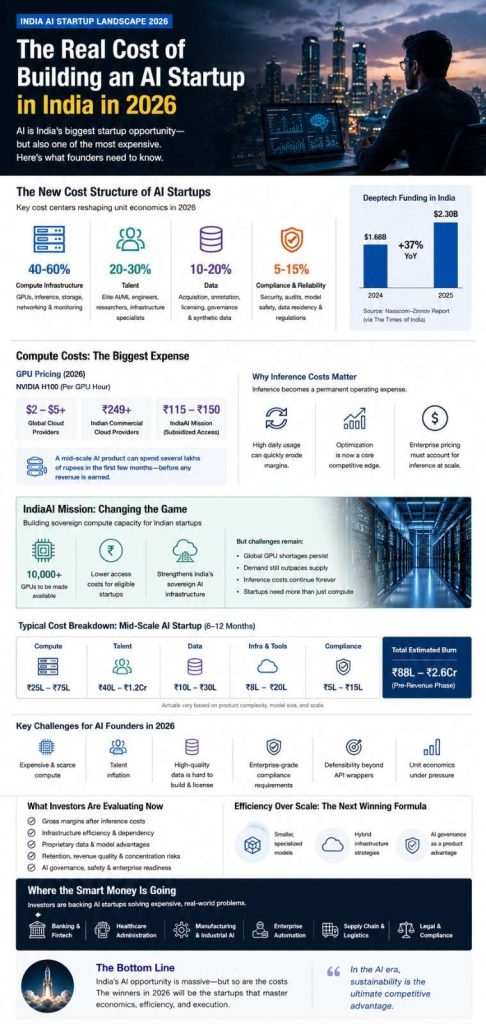
Recent reports show growing investor appetite for AI-led deeptech companies in India, even as funding markets remain cautious overall. Deeptech funding in India rose 37% year-on-year to $2.3 billion in 2025, according to a Nasscom-Zinnov report cited by The Times of India.
At the same time, the operational realities of running AI workloads are forcing startups to rethink everything from infrastructure strategy to hiring plans.
The Era of “Cheap AI Startups” Is Ending
For years, Indian startups benefited from a relatively low-cost operating environment. Talent was cheaper than Silicon Valley, cloud adoption was flexible, and SaaS businesses could scale with modest infrastructure spending.
AI changes that equation.
Training large models, fine-tuning open-source systems, or running enterprise-grade inference at scale now requires sustained access to expensive GPU infrastructure. Founders who initially assumed they could build AI products using API wrappers are discovering that long-term differentiation often demands deeper ownership of models, datasets, or infrastructure layers.
That transition is expensive.
In 2026, the economics of AI startups are increasingly defined by four major cost centers:
- Compute infrastructure
- Specialized talent
- Proprietary or licensed datasets
- Compliance and enterprise reliability
Unlike traditional software startups, many AI companies face heavy infrastructure spending before revenue predictability arrives.
GPUs Have Become the New Office Rent
The single largest expense for many AI startups today is compute.
Access to high-performance GPUs such as NVIDIA H100s, A100s, and L40S systems has become central to AI development. Indian founders increasingly rely on cloud GPU providers instead of purchasing hardware outright because capital expenditure requirements remain prohibitive for early-stage firms.
Industry pricing in 2026 shows how quickly infrastructure bills can escalate.
Cloud-based H100 access globally ranges from roughly $2 to over $5 per GPU hour depending on the provider and configuration.
Indian providers are also offering GPU infrastructure at scale, though pricing still remains substantial for startups running continuous workloads. Estimates from Indian infrastructure providers place H100 cloud pricing at approximately ₹249 per hour and above in many configurations.
Even relatively lean experimentation can become expensive:
Example: Mid-Scale AI Product Development Costs
A startup building a vertical AI assistant for healthcare or fintech may require:
- Multiple GPUs for model fine-tuning
- Dedicated inference clusters
- Vector database infrastructure
- Storage for training data
- Continuous monitoring systems
A few months of iterative experimentation can push infrastructure spending into several lakhs of rupees before monetization stabilizes.
For startups training larger models or serving enterprise customers at scale, monthly GPU bills can rival payroll costs.
This explains why infrastructure optimization has become a boardroom-level conversation inside AI startups.
IndiaAI Mission Is Changing the Cost Equation — But Not Eliminating It
The Indian government’s IndiaAI Mission is attempting to reduce one of the biggest barriers facing AI startups: compute access.
The program aims to create a national compute infrastructure pool with tens of thousands of GPUs available at subsidized rates. Reports in 2026 suggest IndiaAI-linked compute pricing could range between ₹115 and ₹150 per GPU hour for eligible projects, significantly below many commercial market rates.
The initiative represents one of India’s most ambitious attempts to build sovereign AI infrastructure.
But founders say subsidies alone do not solve the broader economics challenge.
Three structural realities remain:
1. Demand Still Outpaces Supply
GPU shortages continue globally, particularly for advanced H100 clusters. Access windows, queue delays, and allocation constraints remain common.
2. Inference Costs Persist Forever
Training is expensive, but inference becomes the recurring operational burden once products scale. Consumer AI products with high daily usage can see margins collapse if inference optimization is weak.
3. AI Startups Need More Than Compute
Founders still require elite engineers, reliable deployment systems, enterprise security frameworks, and proprietary datasets.
Compute subsidies reduce friction. They do not automatically create sustainable AI businesses.
Talent Inflation Has Quietly Accelerated
India still offers one of the world’s deepest software engineering pools, but advanced AI talent has become significantly more expensive.
Experienced machine learning researchers, distributed systems engineers, reinforcement learning specialists, and AI infrastructure architects are now among the most aggressively recruited professionals in the startup ecosystem.
The competition is no longer just between startups.
Global technology firms, hyperscalers, AI labs, and enterprise consulting companies are all competing for the same small pool of experienced AI operators.
Founders say compensation structures increasingly include:
- High fixed salaries
- Significant ESOP allocations
- Remote global compensation benchmarks
- GPU experimentation budgets
- Research publication support
In several cases, AI startups are forced to balance hiring ambition against infrastructure burn.
This creates a difficult tradeoff: spend more on elite talent or spend more on compute.
The API Wrapper Problem
One of the defining debates in India’s AI ecosystem in 2026 revolves around defensibility.
Many early AI startups launched by building lightweight products on top of foundational models from global AI companies. While this reduced initial development costs, investors have become increasingly cautious about businesses with limited proprietary technology.
The concern is straightforward:
If the underlying model provider improves its native product, what remains defensible about the startup?
As a result, founders are now investing more heavily in:
- Proprietary workflows
- Domain-specific datasets
- Fine-tuned models
- Enterprise integrations
- AI agents with operational depth
- Local-language AI capabilities
These strategies improve differentiation but substantially increase operational complexity and costs.
Data Is Becoming a Competitive Moat
Training and fine-tuning high-performing AI systems increasingly depends on data quality rather than just raw compute.
Indian startups building in healthcare, legaltech, fintech, logistics, manufacturing, and regional-language AI are spending heavily on:
- Data acquisition
- Annotation
- Human review systems
- Synthetic data generation
- Compliance frameworks
- Licensing agreements
Data governance is becoming especially important after India’s evolving digital privacy regulations and DPDP-related compliance expectations.
Founders working with enterprise clients now face additional obligations around:
- Data residency
- Security audits
- Explainability
- AI safety protocols
- Model transparency
These requirements increase trust but also raise operational overhead.
Enterprise AI Is Growing Faster Than Consumer AI
One important shift in 2026 is that enterprise AI companies appear financially healthier than purely consumer-facing AI startups.
The reason is economic discipline.
Consumer AI products often require:
- Massive inference usage
- Heavy marketing spend
- Continuous engagement loops
Enterprise AI firms, by contrast, can:
- Price contracts annually
- Pass infrastructure costs into enterprise pricing
- Optimize usage patterns
- Focus on high-value workflows
This partly explains why investors increasingly favor AI startups solving operational problems in sectors like:
- Banking
- Manufacturing
- Customer support
- Healthcare administration
- Supply chain management
- Enterprise automation
The AI excitement cycle is gradually giving way to a revenue-quality cycle.
India’s Infrastructure Race Is Intensifying
The infrastructure layer itself has become a strategic battleground.
Indian conglomerates, cloud firms, and datacenter operators are rapidly expanding AI infrastructure capacity. Large-scale investments from companies linked to renewable-powered datacenters and sovereign compute initiatives reflect India’s ambition to become a global AI infrastructure hub.
This is not only about serving Indian startups.
India increasingly wants to position itself as:
- A lower-cost AI compute destination
- A sovereign cloud market
- A regional AI infrastructure exporter
- A long-term datacenter economy
The strategy mirrors India’s earlier digital public infrastructure playbook in payments and identity systems.
Whether India can translate infrastructure ambition into globally competitive AI companies remains an open question.
Investors Are Asking Harder Questions in 2026
The funding environment has matured significantly.
During the first wave of generative AI enthusiasm, many startups raised capital based primarily on market momentum and AI positioning.
That window is narrowing.
Investors now increasingly evaluate:
- Gross margins after inference costs
- Long-term compute dependency
- Retention quality
- Proprietary data advantages
- AI infrastructure efficiency
- Revenue concentration risks
- Unit economics
The market is rewarding startups that can demonstrate operational discipline rather than just AI branding.
Several investors privately acknowledge that the next major AI winners in India may not necessarily be the companies training the largest models, but the firms best able to control infrastructure costs while building defensible distribution.
The Future Outlook: Efficiency May Matter More Than Scale
The next phase of India’s AI startup ecosystem may belong to companies that master efficiency rather than excess.
Three trends are likely to shape the sector over the next few years:
Smaller Specialized Models
Not every company needs frontier-scale foundational models. Domain-specific compact models are becoming economically attractive.
Hybrid Infrastructure Strategies
Startups increasingly combine:
- Public cloud
- Subsidized national compute
- Dedicated inference clusters
- Open-source models
to reduce dependency on hyperscaler pricing.
AI Governance as a Product Advantage
Enterprise customers are prioritizing:
- Compliance
- Reliability
- Auditability
- Data control
Trust may become as valuable as model quality itself.
Conclusion
India’s AI startup ecosystem in 2026 sits at a pivotal moment.
The opportunity is enormous. Investor interest remains strong. Government infrastructure initiatives are accelerating. Enterprises are adopting AI faster than before.
But beneath the optimism lies a harsher operational reality.
Building an AI startup today is no longer just about writing code and acquiring users. It requires managing compute economics, infrastructure reliability, talent scarcity, compliance obligations, and increasingly sophisticated investor scrutiny.
The winners of the next AI cycle in India may not be the loudest companies or the most heavily funded ones.
They may simply be the startups that learn how to survive the economics of AI before everyone else does.
Also Read : Why India’s AI Startup Boom May Create More Shutdowns Than Unicorns by 2028
Add Startup Chronicle as a preferred source on Google- Click Here
Last Updated on Wednesday, May 20, 2026 9:38 am by Startup Chronicle Team
About The Author