
Introduction
For nearly two years, India’s startup ecosystem has witnessed a familiar pattern repeat itself at extraordinary speed.
A new AI capability emerges globally — AI chatbots, AI coding assistants, AI agents, document summarizers, voice copilots, workflow automation tools — and within weeks, dozens of Indian startups launch near-identical products built on top of the same foundation models from companies like OpenAI, Anthropic, or Google.
Many of these startups raised early funding, attracted social media attention, and positioned themselves as “AI-first companies.” But a growing number of investors, operators, and enterprise buyers are beginning to ask a harder question:
What happens when the underlying platform providers absorb those features themselves?
That question is becoming existential for a large segment of India’s emerging generative AI startup ecosystem.
The issue is not that building on top of existing AI models is inherently weak. Nearly every modern software company depends on foundational infrastructure. The problem is that a substantial number of Indian AI startups have created businesses with little proprietary technology, weak distribution advantages, low switching costs, and minimal defensibility.
As large language models become cheaper, more powerful, and increasingly multimodal, many “wrapper startups” risk being commoditized faster than traditional SaaS companies ever were.
India’s AI ecosystem is still growing rapidly. But beneath the optimism, a painful market correction may already be underway.
India’s AI Startup Explosion Happened at Unprecedented Speed
India has rapidly become one of the world’s largest generative AI startup hubs.
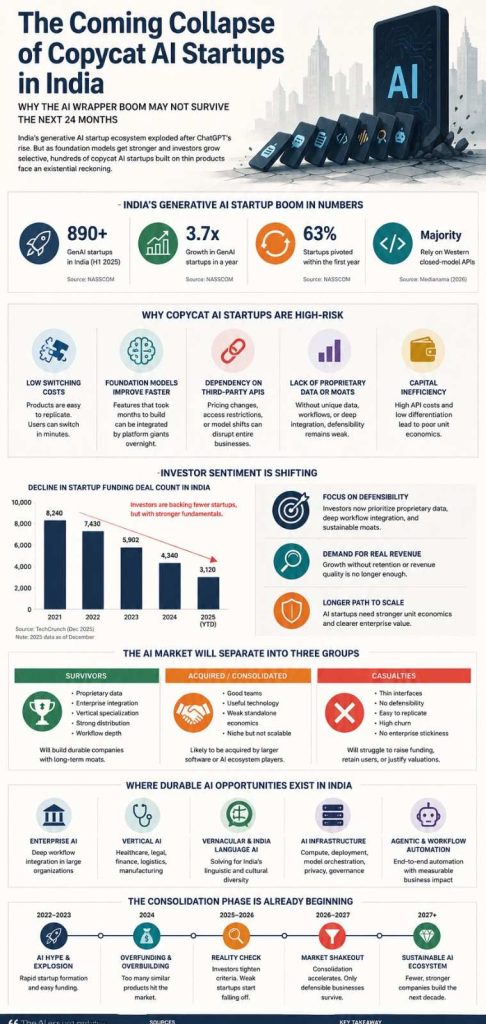
According to a 2025 report from NASSCOM, India’s GenAI startup ecosystem grew 3.7x, reaching more than 890 startups by the first half of 2025. Application-layer startups accounted for the overwhelming majority of that growth.
The report also noted that 63% of Indian GenAI startups had already pivoted their business models within a year — a sign of how unstable and experimental the market remains.
That explosive growth was driven by several converging factors:
- Falling barriers to AI product development
- Easy access to APIs from global model providers
- Massive investor interest after ChatGPT’s rise
- India’s strong SaaS engineering talent pool
- Lower infrastructure costs for application-layer products
- Enterprises rushing to “adopt AI”
But rapid startup formation often creates overcrowding before sustainable demand emerges.
In many sectors — customer support automation, AI writing, AI presentations, sales copilots, recruitment screening, productivity assistants — dozens of nearly indistinguishable startups began competing for the same customers with marginal differentiation.
The result was predictable: feature convergence, pricing pressure, and shallow product moats.
The “Wrapper” Problem Is Real — But Often Misunderstood
The phrase “AI wrapper” has become common in investor circles, sometimes unfairly.
Not every application-layer AI startup is weak.
Historically, many successful software companies were built on top of larger infrastructure ecosystems. Companies rarely build every layer of technology themselves. Even global SaaS leaders rely on cloud infrastructure providers, open-source frameworks, and third-party APIs.
The real issue is whether a startup creates durable value beyond the underlying model.
A startup becomes vulnerable when:
- the core product can be replicated quickly,
- the underlying model provider can integrate the same feature,
- users can switch easily,
- and the company owns little proprietary data, workflow integration, or distribution.
This is already happening globally.
When foundation model providers added capabilities like document analysis, image generation, coding support, voice interaction, memory, browsing, or agentic workflows directly into their products, several standalone startups immediately lost differentiation.
India’s ecosystem is especially exposed because many startups focused on speed-to-market rather than deep defensibility.
A 2026 survey cited by Medianama found that a large majority of Indian AI startups relied primarily on Western closed-model APIs rather than building foundational infrastructure or proprietary models.
That dependency creates structural risk.
If pricing changes, API access tightens, or native platform features improve dramatically, entire product categories can weaken overnight.
Venture Capital Is Becoming Far More Selective
Investor sentiment around AI in India remains strong — but increasingly cautious.
The first phase of the AI boom rewarded speed and narrative. The next phase is rewarding durability.
According to reporting from TechCrunch, Indian startup funding in 2025 showed a sharp decline in total deal count even as investors concentrated capital into fewer companies with clearer product-market fit and stronger business fundamentals.
The same report noted that India still lacks a globally scaled AI-first company generating revenue at the level seen in leading international AI firms.
That gap matters.
Investors are increasingly differentiating between:
- temporary AI feature businesses,
- workflow automation tools,
- vertical AI software,
- and companies building defensible infrastructure or proprietary data ecosystems.
Many early-stage AI startups may discover that raising seed funding during the hype cycle is far easier than surviving long enough to become a meaningful business.
Why Copycat AI Startups Are Especially Vulnerable in India
1. Low Switching Costs
Most generative AI products today offer similar experiences:
- chat interfaces,
- document generation,
- summarization,
- workflow prompts,
- AI agents,
- and automation layers.
If users can move between products in minutes, customer retention becomes fragile.
Unlike traditional enterprise SaaS platforms, many AI startups have not yet embedded themselves deeply into customer workflows.
2. Foundation Models Are Improving Faster Than Startups Can Differentiate
The underlying AI models are evolving at extraordinary speed.
Capabilities that required standalone startups in 2023 or 2024 are increasingly becoming native platform features in 2026.
This compresses the window for startups to build defensible businesses.
A startup may spend months building:
- PDF intelligence,
- AI research agents,
- multilingual support,
- memory systems,
- workflow automation,
- or voice interaction,
only to see those features integrated directly into large foundational platforms shortly afterward.
3. India’s Ecosystem Still Overindexes on SaaS Replication
India’s startup ecosystem historically excelled at adapting proven global software models for local or emerging-market contexts.
That strategy worked well in SaaS, fintech, commerce, and edtech because execution, localization, and distribution created meaningful barriers.
AI changes the equation.
When the core intelligence layer itself becomes globally accessible through APIs, replication cycles become dramatically shorter.
The challenge is no longer just software execution. It is proprietary data, workflow depth, infrastructure efficiency, enterprise integration, domain expertise, and distribution trust.
4. Compute and Infrastructure Remain Structural Weaknesses
Deep AI infrastructure remains expensive.
A 2025 study highlighted by Moneycontrol noted that Indian AI startups continue to face barriers around compute access, funding, and dependency on global AI ecosystems.
Training large foundational models requires enormous capital, compute access, research talent, and long-term patience from investors.
That makes it difficult for Indian startups to compete directly with US or Chinese frontier model companies.
As a result, many founders default toward low-capital application-layer products instead.
Not Every Application-Layer Startup Will Fail
The collapse narrative can also become overly simplistic.
Some of the world’s largest software companies are, technically, “wrappers” around deeper infrastructure layers.
The real question is whether startups create enduring advantages.
Several categories still appear highly promising in India:
Vertical AI
AI products deeply embedded in:
- healthcare,
- legal workflows,
- manufacturing,
- logistics,
- agriculture,
- financial compliance,
- insurance,
- and government systems
can develop strong defensibility because domain complexity matters more than raw model access.
India-Specific Language and Workflow AI
India’s linguistic and operational diversity remains underserved globally.
Products optimized for:
- Indic languages,
- vernacular voice interfaces,
- regulatory workflows,
- public infrastructure,
- and local business processes
may create stronger long-term differentiation than generic AI productivity tools.
NASSCOM’s report specifically highlighted vernacular AI and domain-specific AI as major opportunity areas for India.
Enterprise AI With Deep Integration
Enterprise customers rarely buy AI tools purely for novelty.
They buy:
- reliability,
- compliance,
- workflow integration,
- security,
- governance,
- and measurable productivity gains.
Startups that become deeply integrated into enterprise systems can create meaningful switching costs even without owning foundational models.
Infrastructure and Efficiency Layers
As AI usage scales, demand is growing for:
- inference optimization,
- model orchestration,
- AI governance,
- deployment tooling,
- privacy infrastructure,
- synthetic data systems,
- and local compute management.
These may become more durable businesses than generic AI assistants.
The Market Is Entering Its Consolidation Phase
India’s AI ecosystem is unlikely to collapse broadly.
But a significant consolidation appears increasingly likely.
The market may separate into three groups:
Survivors
Companies with:
- proprietary data,
- enterprise relationships,
- distribution strength,
- vertical specialization,
- or infrastructure advantages.
Acquired Startups
Teams with good talent but weak standalone economics may get absorbed into larger software firms or global AI ecosystems.
Casualties
Startups dependent entirely on thin interfaces around commoditized AI capabilities may struggle to retain users, raise capital, or justify valuations.
This pattern is not unique to India.
Every major technology wave creates speculative excess:
- dot-com startups,
- clone ecommerce platforms,
- crypto tokens,
- quick-commerce clones,
- edtech expansion,
- and now generative AI.
The difference with AI is the speed of commoditization.
India’s Next AI Winners Will Likely Look Very Different
The strongest Indian AI companies of the next decade may not resemble today’s viral AI-product startups.
They may instead focus on:
- domain-specific enterprise systems,
- regulated industries,
- Indian language AI,
- industrial automation,
- healthcare intelligence,
- infrastructure tooling,
- AI governance,
- robotics,
- or sovereign AI ecosystems.
Increasingly, investors are asking tougher questions:
- What proprietary advantage exists?
- What happens if OpenAI launches the same feature?
- Does the startup own unique data?
- Can customers switch easily?
- Is the company solving a painful operational problem or just showcasing AI capability?
Those questions will determine survival.
Conclusion
India’s generative AI boom is real. But so is the coming correction.
The next few years will likely expose the difference between:
- companies using AI as a temporary growth narrative,
- and companies building durable businesses around structural problems.
Many copycat AI startups may disappear not because AI itself is overhyped, but because commoditized software layers rarely sustain long-term venture-scale businesses.
At the same time, dismissing all application-layer AI startups as “wrappers” would also be a mistake.
Some of India’s most valuable future AI companies may still emerge from the application layer — but only if they build defensible systems around proprietary workflows, enterprise integration, data, trust, and localization.
The AI era is not ending.
The easy AI era probably is.
Also Read : The Real Cost of Building an AI Startup in India in 2026
Add Startup Chronicle as a preferred source on Google- Click Here
Last Updated on Wednesday, May 20, 2026 11:52 am by Startup Chronicle Team
About The Author
