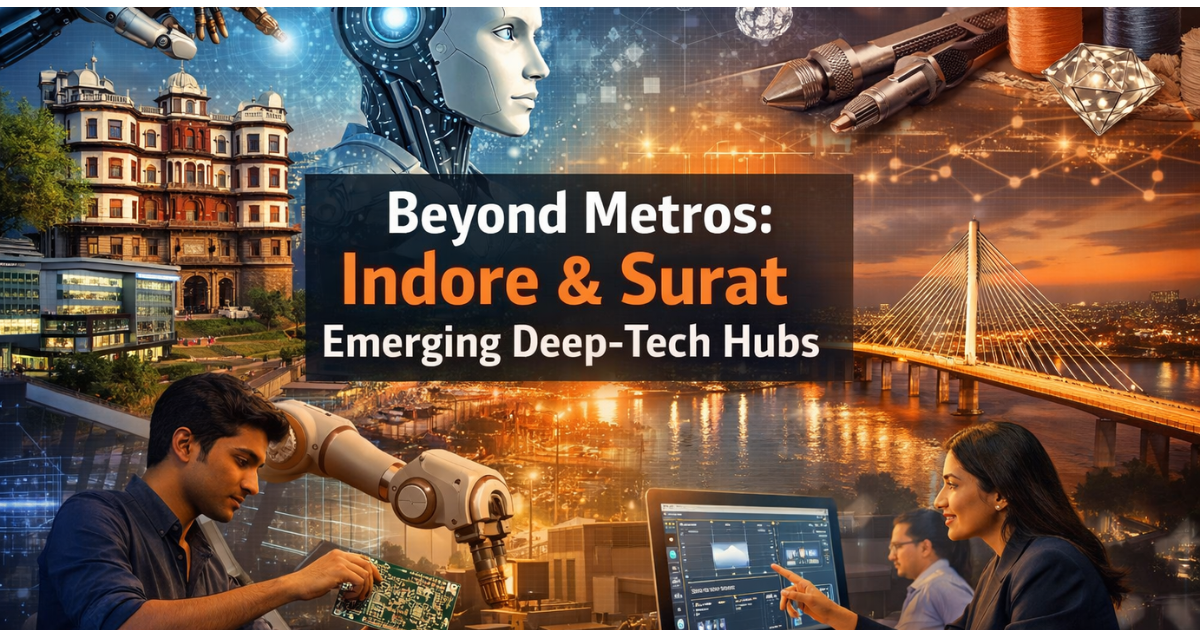
For decades, India’s technology and innovation narrative revolved almost entirely around its largest metropolitan cities. Bengaluru, Mumbai, Delhi–NCR, Hyderabad and Chennai dominated conversations on startups, venture capital, research labs and emerging technologies. Today, however, a quieter but far more transformative shift is underway. Tier-2 cities such as Indore and Surat are steadily positioning themselves as India’s next deep-tech hubs, redefining where innovation is built and who gets to participate in the country’s digital future.
This transition is not accidental. It is the result of structural changes in India’s economy, improvements in infrastructure, evolving founder mindsets and deliberate policy efforts to decentralize innovation. As deep-tech startups focus on artificial intelligence, advanced analytics, robotics, clean energy, automation and industrial technologies, they are discovering that the advantages they need no longer exist only in metros.
Indore offers a compelling case study of this transformation. Long known as a commercial and educational center in central India, the city has quietly developed an ecosystem that supports technology-driven entrepreneurship. Improved urban planning, reliable civic infrastructure and a growing focus on quality of life have made Indore attractive to young professionals who no longer see migration to a metro as a necessity. Educational institutions in and around the city are producing a steady pipeline of engineering, management and research talent, many of whom are choosing to stay back and build locally rather than relocate.
What sets Indore apart is its growing emphasis on applied deep-tech. Startups in the city are working on AI-driven enterprise solutions, logistics optimization platforms, health-tech tools and automation software tailored for Indian and global markets. With lower operational costs, founders are able to invest more time and resources into research, product development and long-term problem-solving, which is critical for deep-tech ventures that typically have longer gestation periods.
Surat, on the other hand, represents a different but equally powerful model of deep-tech growth. Traditionally associated with diamonds, textiles and manufacturing, Surat has leveraged its strong industrial base to build technology solutions that are deeply integrated with real-world business needs. Entrepreneurs in the city are developing SaaS platforms, AI-powered supply chain tools and data-driven enterprise software that serve manufacturing, export and trade-focused industries.
The city’s entrepreneurial culture, shaped over generations of business ownership and risk-taking, has seamlessly adapted to the digital age. Rather than building consumer internet products alone, many Surat-based startups are focusing on enterprise and industrial deep-tech, using software and advanced analytics to improve efficiency, reduce costs and enhance global competitiveness for businesses. This practical, problem-solving approach has helped local startups attract customers and revenue early, even as they build sophisticated technology stacks.
One of the biggest drivers behind the rise of Tier-2 deep-tech hubs is cost efficiency. Office space, talent acquisition and operational expenses are significantly lower than in major metros. For deep-tech startups, which often require sustained investment before commercialization, this cost advantage can be the difference between survival and shutdown. Lower burn rates allow founders to experiment, iterate and invest in research without the constant pressure of short-term fundraising.
Talent dynamics are also changing rapidly. A growing number of engineers, data scientists and product managers prefer to work from their home cities, especially as remote collaboration tools and digital infrastructure improve. This reverse migration has strengthened local talent pools and reduced dependence on metro-centric hiring. For startups in Indore and Surat, access to skilled professionals is no longer a constraint but a competitive advantage.
Government initiatives at both the central and state levels have further accelerated this shift. Startup policies, incubation programs, seed funding schemes and innovation grants are increasingly focused on Tier-2 and Tier-3 cities. These efforts are not just about increasing startup numbers but about building sustainable ecosystems that support research, intellectual property creation and long-term value generation. Incubation centers, academic partnerships and industry linkages in cities like Indore and Surat are creating environments where deep-tech companies can scale without relocating.
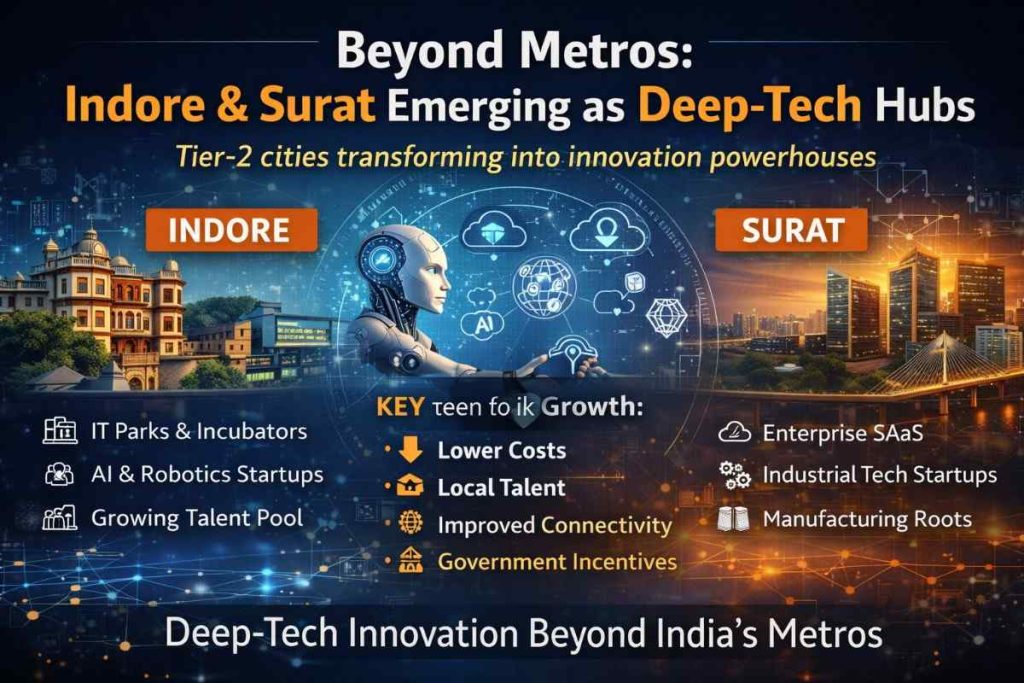
Improved physical and digital connectivity has also played a crucial role. Better highways, expanding air routes and reliable internet access mean founders can operate global businesses from smaller cities without sacrificing reach or credibility. Investors, mentors and enterprise clients are now just a video call or short flight away, reducing the historical disadvantages associated with non-metro locations.
The broader implications of this trend are significant. As deep-tech innovation spreads beyond metros, economic growth becomes more balanced and inclusive. Jobs are created closer to where people live, reducing urban congestion and pressure on metro infrastructure. Regional economies diversify beyond traditional industries, making them more resilient to economic cycles. At the national level, India’s deep-tech ambitions gain scale and depth as innovation is no longer concentrated in a few urban pockets.
Indore and Surat are not exceptions; they are early indicators of a larger transformation unfolding across India. Cities that once played supporting roles in the country’s economic story are now emerging as centers of serious technological innovation. As deep-tech becomes central to India’s global competitiveness, the rise of Tier-2 hubs signals a future where innovation is distributed, grounded in real-world problems and driven by local talent with global ambition.
The next chapter of India’s technology story, it appears, will not be written in metros alone. It will be shaped equally by cities like Indore and Surat, where deep-tech is taking root quietly but decisively, redefining what it means to build world-class technology from the heart of India.
Add startupchronicle.in as preferred source on google – Click Here
Last Updated on Tuesday, January 27, 2026 4:40 am by Startup Chronicle Team
About The Author
