
The stock market debut of Shadowfax Technologies marks a defining moment for India’s new-age logistics sector, one that has spent the past decade quietly building scale in the background of the country’s e-commerce boom. As Shadowfax transitions from a fast-growing private startup into a publicly traded company, its IPO offers a revealing case study for other logistics and supply-chain startups preparing to test the public markets in 2026.
Shadowfax’s journey to Dalal Street was neither sudden nor accidental. Founded as a last-mile delivery platform, the company rode the explosive growth of online commerce, quick-commerce and hyperlocal delivery, positioning itself as a technology-driven, asset-light logistics partner. By the time it filed its offer documents, Shadowfax had built a nationwide network covering most Indian PIN codes and had emerged as a key logistics partner for major e-commerce marketplaces, food delivery platforms and direct-to-consumer brands.
The IPO itself was structured to raise fresh capital for growth while allowing early investors to partially monetise their stakes. This balance is becoming increasingly common among venture-backed startups going public, reflecting the dual objectives of funding expansion and providing exits after long holding periods. Subscription levels indicated healthy interest, particularly from retail investors, signalling that logistics as a sector continues to attract attention despite broader market volatility.
Yet the company’s listing performance was measured rather than euphoric. The shares debuted at a modest discount to the issue price, underscoring a reality that many startups now face: public markets are far less forgiving than private capital when it comes to valuation expectations. Investors today are scrutinising fundamentals more closely, especially in sectors like logistics where margins are thin and competition is intense.
This muted debut should not be read as a rejection of Shadowfax’s business model. Instead, it reflects a recalibration of expectations. For years, private markets rewarded scale and growth above all else. Public markets, however, demand visibility on profitability, resilience and long-term sustainability. Shadowfax’s experience highlights the growing gap between private-market optimism and public-market discipline.
At the heart of investor scrutiny lies the economics of logistics itself. Even with technology and scale, last-mile delivery remains a cost-heavy business. Fuel prices, delivery partner incentives, customer service costs and infrastructure investments can quickly erode margins. While Shadowfax has demonstrated strong revenue growth and improving operational efficiencies, investors remain cautious about how quickly such efficiencies can translate into consistent profits.
Another theme that emerged during the IPO process was revenue concentration. Like many logistics startups that grew alongside India’s e-commerce giants, Shadowfax derives a significant share of its volumes from a limited number of large clients. While these relationships provide scale and stability, they also create vulnerability. Public-market investors tend to discount businesses that are overly dependent on a handful of customers, fearing sudden shifts in bargaining power or demand.
Workforce dynamics also weighed on sentiment. Shadowfax’s model, like much of the sector, relies heavily on a gig-based delivery workforce. As regulatory conversations around gig worker rights intensify, companies face uncertainty over future costs and compliance requirements. Investors are increasingly asking how logistics firms plan to balance flexibility with regulatory resilience, a question that will only grow louder in the coming years.
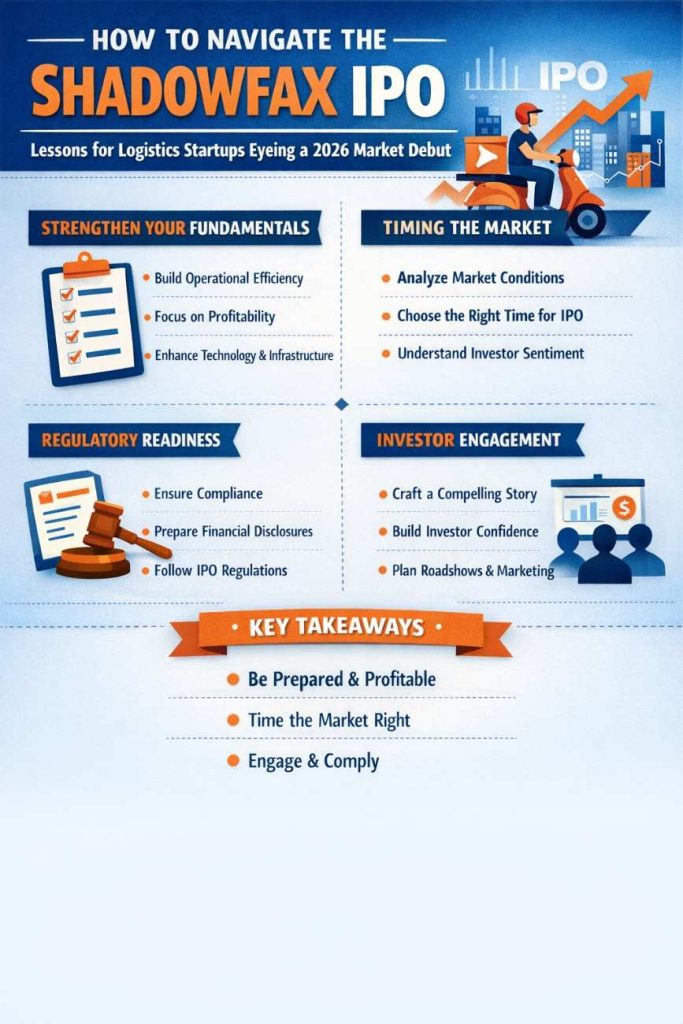
Despite these challenges, Shadowfax’s IPO carries important lessons for logistics startups planning to go public in 2026. One of the clearest is the importance of timing and pricing. The company’s decision to moderate its valuation expectations before listing likely helped ensure subscription success, even if it meant foregoing a more aggressive price. Startups considering an IPO must recognise that credibility and post-listing performance often matter more than headline valuations.
Another lesson lies in narrative building. Shadowfax positioned itself not merely as a delivery company, but as a technology-enabled logistics platform with multiple service lines and growth levers. This broader narrative is essential in a sector often perceived as commoditised. Startups must articulate how technology, data and network effects create defensible advantages and improve unit economics over time.
Perhaps most importantly, Shadowfax’s journey underscores the need for balance between growth and discipline. Public markets are no longer rewarding growth at any cost. Logistics startups eyeing a 2026 debut will need to show clearer paths to profitability, diversified client bases and the ability to withstand regulatory and economic shocks.
In that sense, Shadowfax’s IPO is less a verdict and more a signal. It signals that India’s logistics sector has matured enough to enter the public markets, but also that the rules of engagement have changed. For startups watching closely, the message is clear: scale still matters, but sustainability, transparency and realism matter more.
Also read : https://businessmax.in/why-indian-founders-are-doubling-down-on-credible-manufacturing-in-2026/
Add startupchronicle.in as preferred source on google – Click Here
Last Updated on Wednesday, January 28, 2026 12:46 pm by Startup Chronicle Team
About The Author