
India’s rapid digital transformation has ushered in a new era for technology startups, but it has also brought the pressing challenge of personal data protection into sharp focus. The Digital Personal Data Protection Act, 2023 (DPDPA) has emerged as a critical piece of legislation, setting out comprehensive rules for how businesses handle, process, and store personal data. For startups that rely heavily on digital platforms and user data, understanding and complying with the Act is no longer optional—it is central to operational integrity, investor confidence, and customer trust.
The law was designed to bring India’s data privacy standards closer to global benchmarks while accounting for the unique dynamics of the country’s digital ecosystem. At its core, the DPDPA distinguishes between “data fiduciaries,” the entities that determine the purpose and means of data processing, and “data principals,” the individuals whose data is collected and used. Most tech startups act as data fiduciaries, as they routinely collect personal information ranging from basic identity details to financial and behavioral data. This makes compliance not just a regulatory obligation but a strategic priority.
Under the Act, startups are required to obtain clear and informed consent from users before processing their personal data. The consent must be explicit, freely given, and capable of being withdrawn at any time. Any collection of data must be purpose-specific, and companies cannot repurpose user data without obtaining fresh consent. Transparency is also a legal requirement: startups must communicate their data handling practices in a manner that is clear and accessible, enabling users to understand what data is being collected, for what purpose, and how it will be used.
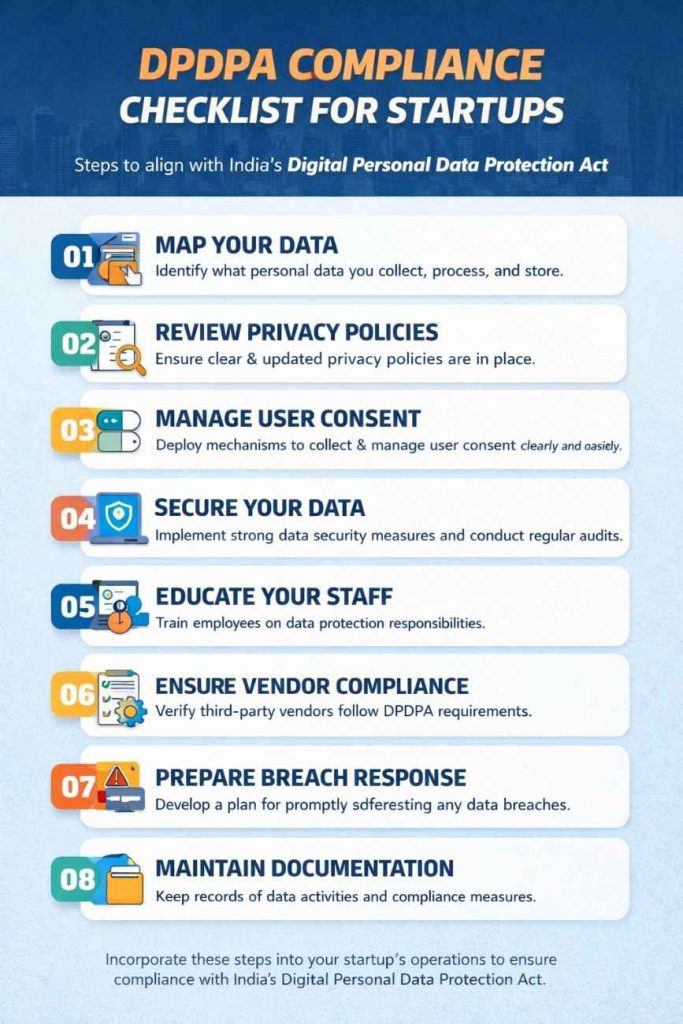
Data security is another pillar of the legislation. Startups are expected to adopt reasonable security practices to protect personal data from unauthorized access, breaches, or misuse. While the law does not prescribe specific technological solutions, it emphasizes that companies must demonstrate that they have implemented adequate safeguards. Furthermore, individuals have rights over their data, including the ability to access, correct, delete, or transfer their information. Startups must ensure mechanisms are in place to honor these rights efficiently and within the timelines outlined in the Act.
The DPDPA also establishes protocols for reporting data breaches. Any incident that compromises personal data must be notified to the Data Protection Authority of India (DPAI) promptly. This requires startups to maintain an internal framework capable of detecting breaches quickly, containing potential damage, and communicating incidents transparently to regulators and users.
For many startups, compliance presents a significant operational challenge. Limited resources, rapid product development cycles, and the use of third-party tools can complicate adherence to the law. Despite these hurdles, industry experts argue that startups that integrate privacy and data protection into their business practices early stand to gain a competitive advantage. Consumers increasingly value platforms that respect privacy, and investors are paying closer attention to governance and risk management practices when evaluating new ventures.
The Digital Personal Data Protection Act represents more than a set of legal obligations; it embodies a vision of ethical data management and digital trust. By embedding compliance into their operations from the outset, startups can mitigate legal and reputational risks while strengthening relationships with users and stakeholders. As India continues to expand its digital footprint, adherence to the DPDPA will be a defining factor in the long-term success of the country’s tech startups.
Add startupchronicle.in as preferred source on google – Click Here
Last Updated on Monday, February 2, 2026 9:28 am by Startup Chronicle Team
About The Author
