
For nearly a decade, India’s startup ecosystem operated inside a powerful media flywheel.
Startups raised capital. Funding announcements generated headlines. Headlines attracted customers, talent, and more investors. Repeat.
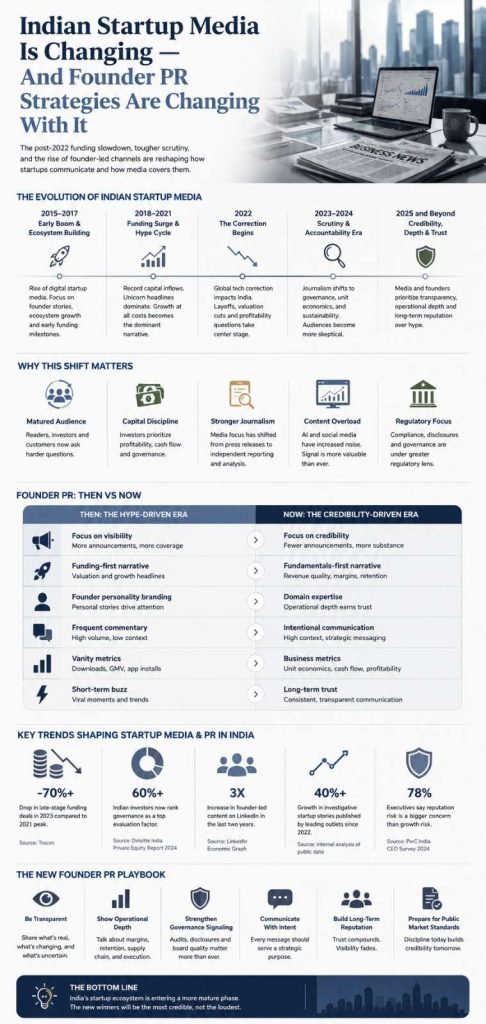
In the low-interest-rate era between roughly 2015 and 2021, startup media in India became deeply intertwined with venture capital momentum. Stories about valuations, unicorn milestones, founder charisma, and rapid growth dominated coverage across business publications, startup blogs, YouTube channels, LinkedIn commentary, and Twitter/X discourse.
But the environment has shifted sharply.
The funding slowdown that followed the global tech correction of 2022 changed not only startup economics, but also the economics and incentives of startup journalism itself. Venture funding became harder. IPO scrutiny increased. Governance failures surfaced. Profitability suddenly mattered. Layoffs became recurring headlines. Investors became more cautious. Audiences became more skeptical.
And as startup media evolved, founder public relations strategies evolved with it.
Today, many Indian founders are discovering that visibility alone is no longer enough. Media strategy is increasingly about credibility, transparency, defensibility, and long-term trust rather than simply generating hype.
The result is a structural shift in how startups communicate with journalists, investors, customers, and the broader market.
The Funding Boom Created a Particular Kind of Startup Media
India’s startup media landscape expanded rapidly during the peak venture cycle.
Publications such as YourStory, Inc42, Entrackr, The Ken, and mainstream business outlets including Economic Times and Moneycontrol significantly expanded startup coverage as venture activity accelerated across fintech, edtech, SaaS, e-commerce, and mobility.
The startup boom coincided with several structural trends:
- record venture capital inflows into India
- growing retail investor interest in startups
- the rise of founder influencers on social media
- increased startup advertising spending
- strong demand for entrepreneurial success stories
- rapid digital media consumption growth
During this period, startup coverage often prioritized:
- funding rounds
- valuation milestones
- founder personalities
- rapid hiring
- expansion announcements
- “next unicorn” narratives
That approach reflected market realities at the time. Venture capital rewarded growth aggressively, and media narratives frequently mirrored investor optimism.
But this model had limitations.
In many cases, coverage became overly dependent on funding announcements rather than operational depth. Startups learned that visibility could be engineered through PR cycles even when unit economics remained weak or business fundamentals were unclear.
Several high-profile governance controversies later exposed the risks of excessively celebratory coverage.
The Credibility Shock After 2022
The post-2022 correction changed the tone of startup journalism globally, including in India.
The collapse or slowdown of multiple high-profile startups worldwide increased scrutiny on:
- profitability claims
- accounting practices
- governance structures
- cash burn
- related-party transactions
- layoffs
- founder compensation
- AI-related hype cycles
- sustainability of business models
India experienced its own wave of startup stress.
Companies across edtech, quick commerce, D2C, crypto, and mobility sectors faced difficult questions around financial discipline and governance. Media organizations that previously emphasized growth narratives began investing more heavily in investigative reporting, financial analysis, and accountability journalism.
This transition has been visible in the reporting styles of publications such as The Ken, Entrackr, and mainstream business desks covering startup finance and regulation.
The shift also reflects broader audience maturity.
Readers today are more likely to ask:
- Is the business actually profitable?
- How defensible is the moat?
- Are revenue numbers sustainable?
- What does retention look like?
- Is AI genuinely core to the business or just branding?
- How dependent is the company on venture subsidies?
This is changing how founders approach public relations.
Founder PR Is Moving From Visibility to Trust
For years, many startup PR strategies in India revolved around maximizing founder visibility.
That often included:
- constant funding announcements
- podcast appearances
- LinkedIn personal branding
- media exclusives
- growth projections
- aggressive “thought leadership”
- social media virality
Some of these tactics still matter. But founders are increasingly recognizing that overexposure can create reputational risk if execution does not match public narratives.
Today, startup communications teams are placing greater emphasis on:
Financial Transparency
Founders are becoming more cautious about making exaggerated growth claims.
Journalists and investors now routinely examine:
- audited filings
- profitability metrics
- burn multiples
- customer concentration
- retention data
- compliance history
PR teams increasingly prepare founders for harder questions rather than only celebratory interviews.
Operational Depth
Coverage is shifting toward operational storytelling.
Media outlets now show stronger interest in:
- supply chain execution
- manufacturing capability
- enterprise adoption
- AI infrastructure
- margins
- compliance readiness
- distribution advantages
This especially affects sectors such as:
- deeptech
- climate tech
- SaaS
- semiconductor manufacturing
- EV infrastructure
- logistics
- B2B AI
Reputation Risk Management
Founders are increasingly aware that media cycles can turn quickly.
A single governance controversy or layoff wave can reshape public perception within days.
As a result, crisis communications, internal communications, and stakeholder alignment have become more important than vanity metrics.
The Rise of Founder-Led Media Has Changed the Equation
Another major shift is the growth of founder-owned audiences.
Many Indian startup founders now communicate directly through:
- X/Twitter
- YouTube
- podcasts
- newsletters
- webinars
- founder communities
This reduces dependence on traditional media gatekeepers.
Executives such as Kunal Shah, Nithin Kamath, and Harsh Jain have built substantial direct digital influence through consistent public commentary on startups, regulation, technology, and business strategy.
This trend creates both opportunities and risks.
The Opportunity
Direct channels allow founders to:
- control narrative framing
- communicate rapidly during crises
- explain complex products
- build founder familiarity
- engage customers without intermediaries
The Risk
Founder-led media can also blur the line between expertise and performance branding.
Audiences are becoming more skeptical of:
- motivational startup content
- inflated success narratives
- “hustle culture” messaging
- exaggerated AI claims
- vanity metrics presented without context
As a result, credibility increasingly depends on consistency between public messaging and actual execution.
AI Has Intensified the Noise Problem
Generative AI has dramatically lowered the cost of producing startup content.
Thousands of founders and operators now publish:
- AI-generated LinkedIn posts
- startup threads
- newsletters
- founder essays
- product commentary
- growth frameworks
- market analyses
This has created a content saturation problem.
The abundance of startup commentary means journalists and investors are becoming more selective about what deserves attention.
Simply publishing frequently is no longer enough.
Founders now need:
- differentiated insight
- verifiable execution
- original market understanding
- domain expertise
- operational credibility
Ironically, AI-generated content overload may increase the long-term value of trusted journalism and high-quality editorial analysis.
Startup Media Business Models Are Also Under Pressure
The transformation is not only editorial. It is economic.
Digital media companies globally are facing:
- advertising pressure
- algorithm volatility
- declining referral traffic
- subscription challenges
- AI-driven search disruption
Indian startup media companies are not immune.
This matters because media economics influence editorial priorities.
Some observable trends include:
- greater focus on premium analysis
- subscription-led business models
- investigative reporting
- niche industry coverage
- founder interviews with operational depth
- reduced dependence on pure funding-news cycles
Publications that survive this transition are likely to be those that provide:
- proprietary reporting
- trustworthy analysis
- ecosystem access
- domain expertise
- high-signal journalism
For founders, this means transactional PR relationships are becoming less effective.
Editors increasingly prioritize substance over access.
The IPO Era Is Raising the Bar for Communications
India’s startup ecosystem is gradually entering a more public-market-oriented phase.
The listings of companies such as Zomato, Paytm, Nykaa, and Policybazaar changed expectations around disclosure, governance, and investor communications.
Public markets impose a different communications discipline than private fundraising.
Narratives now require:
- consistency
- quarterly accountability
- realistic guidance
- compliance sensitivity
- investor scrutiny
This has broader ecosystem implications.
Late-stage startups increasingly understand that aggressive media narratives can eventually collide with public-market expectations.
As a result, PR strategies are becoming more conservative and financially grounded.
The New Founder PR Playbook
The next phase of startup communications in India is likely to look very different from the previous decade.
The emerging playbook increasingly includes:
1. Fewer Vanity Announcements
Large funding headlines still matter, but they no longer guarantee positive perception.
Markets now care more about:
- revenue quality
- margins
- retention
- sustainability
- execution consistency
2. More Domain Authority
Founders with deep expertise are gaining more long-term credibility than purely motivational personal brands.
Technical insight increasingly matters in sectors like:
- AI infrastructure
- climate technology
- semiconductors
- enterprise SaaS
- robotics
- healthcare
3. Stronger Governance Signaling
Investors and journalists now pay closer attention to:
- board composition
- audits
- compliance
- disclosures
- ESOP transparency
- accounting discipline
4. Long-Term Reputation Building
Short-term virality is becoming less valuable than durable trust.
Founders who communicate carefully during difficult periods often build stronger reputational resilience over time.
Why This Shift Could Ultimately Benefit the Ecosystem
India’s startup ecosystem is maturing.
The earlier era of hyper-growth storytelling helped attract capital and talent into entrepreneurship. That phase played an important role in ecosystem formation.
But the current transition toward more rigorous journalism and more disciplined founder communications may ultimately produce a healthier market.
Better journalism can:
- improve accountability
- reduce hype cycles
- strengthen investor trust
- surface operational realities
- encourage sustainable company building
Likewise, better founder communications can:
- improve transparency
- align expectations
- reduce reputational volatility
- build durable customer trust
The relationship between startups and media is unlikely to become less important. If anything, it may become more strategic.
But the nature of that relationship is changing.
The next generation of successful Indian founders may not be the loudest voices online. They may simply be the most credible.
Also Read : Flipkart’s 13-Minute Delivery Draws Praise From Walmart CEO as India’s Quick Commerce Race Accelerates
Add Startup Chronicle as a preferred source on Google- Click Here
Last Updated on Saturday, May 23, 2026 1:46 pm by Startup Chronicle Team
About The Author