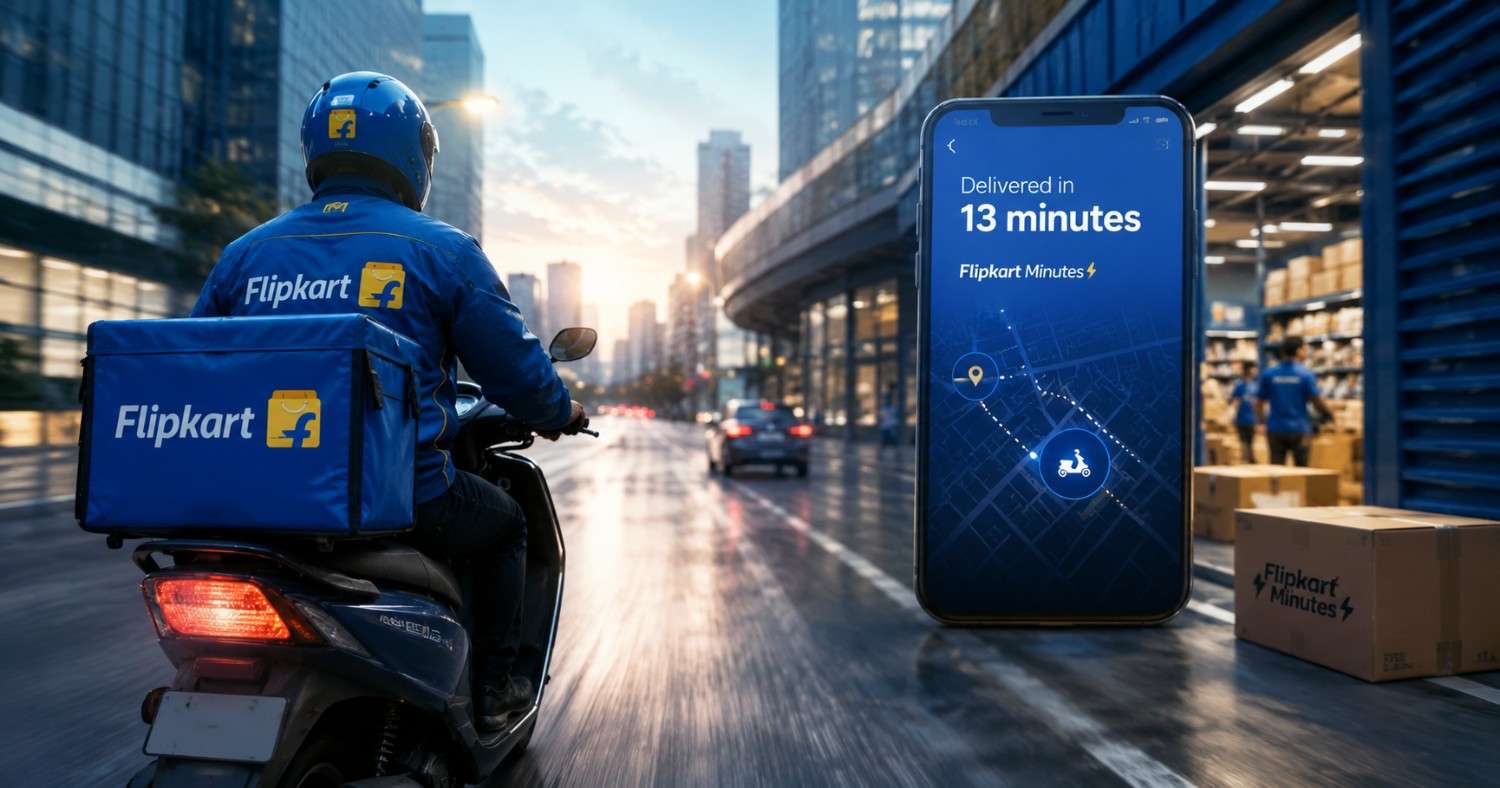
India’s quick commerce market has become one of the most closely watched battlegrounds in global retail, and now it has earned public praise from the top leadership of Walmart.
During Walmart’s Q1 FY2027 earnings call, President and CEO John Furner described Flipkart’s average 13-minute delivery capability as “really impressive,” highlighting the scale and operational sophistication being built by the Walmart-owned ecommerce company in India.
The remarks are significant not only because Walmart owns more than 80% of Flipkart, but also because they signal how central ultra-fast delivery has become to Walmart’s broader international commerce strategy.
As competition intensifies between Flipkart, Blinkit, Zepto, and Swiggy, the conversation is no longer limited to ecommerce convenience. Speed, logistics density, dark-store efficiency, and repeat consumer engagement are increasingly shaping the economics of digital retail in India.
Walmart’s Endorsement Reflects Flipkart’s Growing Strategic Importance
Speaking during the earnings discussion, Furner said:
“Having deliveries in International, and Flipkart in particular, at 13 minutes is really impressive.”
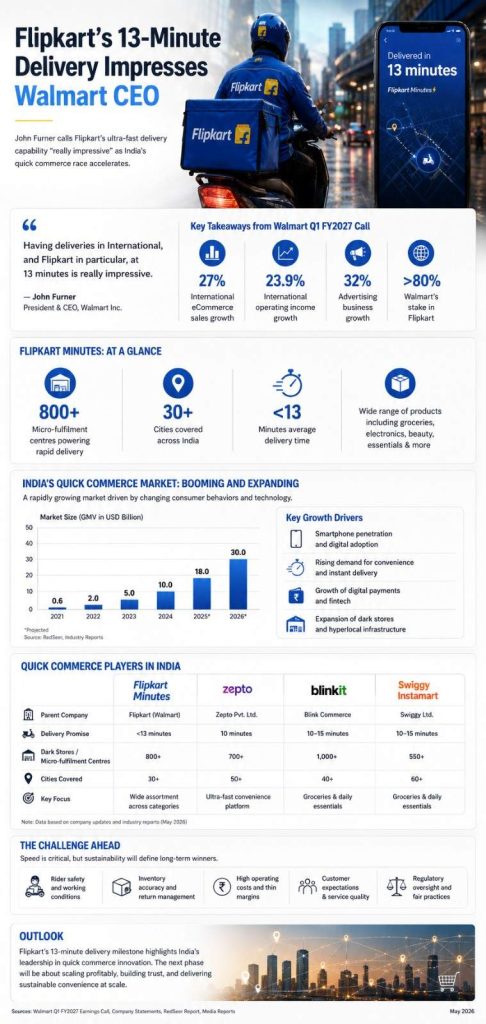
He added that Flipkart currently operates more than 800 micro-fulfilment centres supporting its rapid-delivery service, Flipkart Minutes, with average delivery times below 13 minutes across more than 30 Indian cities.
The comments came shortly after Furner’s India visit earlier this month, during which he met Narendra Modi and reiterated Walmart’s long-term commitment to investing in India through Flipkart and PhonePe.
For Walmart, India is increasingly becoming more than a growth market. It is also serving as a large-scale experimentation ground for high-frequency commerce models that could influence global retail operations.
India’s Quick Commerce Market Has Shifted Consumer Expectations
The rise of quick commerce in India has fundamentally altered urban consumption patterns over the last three years.
What began primarily as grocery delivery has rapidly expanded into electronics, beauty products, household essentials, medicines, fashion accessories, and even premium lifestyle items. Consumers in major Indian cities are now conditioned to expect delivery within minutes rather than days.
This behavioral shift has triggered aggressive investments in:
- dark stores and micro-warehouses
- hyperlocal logistics networks
- AI-driven inventory management
- route optimization systems
- predictive demand analytics
Flipkart’s expansion through Flipkart Minutes reflects this larger industry transition.
Walmart executives also pointed to broader global delivery acceleration trends during the earnings call. In China, Walmart reportedly delivered more than half a billion units in the quarter, with nearly 75% reaching customers within an hour.
The parallels are notable: both India and China are emerging as large-scale testing grounds for ultra-fast ecommerce infrastructure.5rr
Why Flipkart’s 13-Minute Benchmark Matters
On the surface, a 13-minute delivery promise may appear primarily like a marketing milestone. Operationally, however, it represents a deeply complex logistics challenge.
To consistently deliver products within such short time windows, companies need:
Dense Micro-Fulfilment Infrastructure
Flipkart’s reported network of 800+ micro-fulfilment centres indicates a heavy investment in hyperlocal warehousing.
Unlike traditional ecommerce fulfilment centres located on city outskirts, quick-commerce infrastructure must sit close to consumption clusters to reduce travel time.
High Inventory Accuracy
Ultra-fast delivery leaves little room for inventory mismatches. Real-time stock synchronization becomes critical because failed orders directly damage customer trust and profitability.
Efficient Rider Utilization
Delivery speed is not simply about proximity. It also depends on rider allocation efficiency, order batching logic, and traffic-aware routing systems.
Consumer Habit Formation
The economics of quick commerce improve significantly when consumers place frequent, smaller orders. This creates repeat engagement loops that increase lifetime customer value.
For companies like Flipkart, the strategic goal may be less about one-time speed and more about embedding themselves into consumers’ daily purchasing routines.
Walmart’s Global Retail Strategy Is Increasingly Built Around Speed
Walmart’s praise for Flipkart aligns with its own global push toward faster fulfilment and same-day commerce.
The company has been investing heavily in rapid-delivery capabilities in the United States as well. Walmart executives recently said faster delivery is changing customer shopping behavior, particularly for urgent household purchases.
This broader strategy mirrors a growing industry-wide reality:
Retail competition is increasingly shifting from price and assortment toward convenience and immediacy.
For Walmart, Flipkart’s India operations offer valuable operational insights into:
- high-density urban delivery
- rapid fulfilment economics
- localized inventory planning
- mobile-first consumer behavior
- scalable quick-commerce infrastructure
India’s highly competitive market conditions may effectively help Walmart refine systems that can later influence international operations.
The Quick Commerce Boom Comes With Operational Risks
Despite the excitement around delivery speed, the sector continues to face criticism and structural challenges.
India’s government earlier pushed several companies — including Flipkart, Swiggy, and Zepto — to tone down “10-minute delivery” marketing amid concerns around road safety and delivery pressure on riders.
The issue reflects a broader debate within the industry:
How fast is too fast?
Consumer convenience often creates hidden operational stress across:
- delivery workforce conditions
- rider incentives
- traffic safety
- warehouse labor intensity
- return management complexity
Customer complaints around delayed deliveries, inconsistent service quality, and support responsiveness also remain visible across online consumer forums and social platforms.
This creates a difficult balancing act for quick-commerce companies:
They must scale speed aggressively while maintaining operational sustainability and customer trust.
Flipkart’s Role in Walmart’s International Growth Story
Beyond logistics innovation, Flipkart is also becoming financially important for Walmart’s international business.
Walmart reported:
- International ecommerce sales growth of 27%
- International operating income growth of 23.9%
- Advertising business growth of 32%, partly driven by Flipkart momentum
These numbers indicate that Flipkart is no longer just a strategic India bet. It is increasingly contributing to Walmart’s broader digital commerce and advertising ecosystem.
That matters because global retailers are under pressure to improve ecommerce profitability — an area historically challenged by thin margins and high fulfilment costs.
Quick commerce, despite its heavy upfront infrastructure requirements, may eventually create stronger monetization opportunities through:
- advertising
- memberships
- private labels
- higher purchase frequency
- embedded financial services
Can Ultra-Fast Delivery Become Profitable at Scale?
This remains one of the biggest unanswered questions in India’s ecommerce market.
Quick commerce companies have succeeded in driving consumer adoption rapidly, but long-term profitability is still under scrutiny.
Key cost pressures include:
- dark-store rentals
- rider payouts
- inventory wastage
- discounts and incentives
- technology infrastructure
- customer acquisition costs
However, investors and large retailers continue backing the segment because of its strategic value.
The logic is straightforward:
Whoever owns high-frequency daily commerce behavior may eventually control broader consumer spending ecosystems.
That explains why established players like Flipkart are aggressively expanding into rapid delivery despite margin concerns.
The Future of Ecommerce in India May Be Hyperlocal
India’s ecommerce industry is entering a new phase where the distinction between traditional ecommerce and quick commerce is beginning to blur.
Consumers increasingly expect:
- same-hour deliveries
- real-time inventory visibility
- app-native shopping experiences
- frictionless payments
- instant customer support
Flipkart’s evolving infrastructure suggests the company is positioning itself for that future rather than treating quick commerce as a side business.
Walmart’s public endorsement reinforces the idea that India’s rapid-delivery ecosystem is now globally relevant — not just as a local consumer trend, but as a model shaping the next generation of digital retail infrastructure.
Conclusion
Walmart CEO John Furner’s praise for Flipkart’s 13-minute delivery capability highlights more than operational efficiency. It reflects how India’s quick-commerce ecosystem is influencing global retail thinking.
Flipkart’s expansion through micro-fulfilment centres and rapid-delivery networks demonstrates the scale at which ecommerce infrastructure is evolving in India. At the same time, the sector faces mounting pressure to prove profitability, maintain service quality, and address labor and safety concerns.
The next phase of the market will likely depend not only on who delivers fastest, but on who can build sustainable, trusted, and economically viable commerce systems at scale.
For Walmart, Flipkart appears increasingly central to that experiment.
Also Read : Scapia Raises $63 Million to Expand Travel Fintech Play
Add Startup Chronicle as a preferred source on Google- Click Here
Last Updated on Friday, May 22, 2026 11:35 am by Startup Chronicle Team
About The Author
