
For nearly a decade, venture capital rewarded scale above all else. Startups hired aggressively, expanded into multiple markets early, and prioritized growth metrics over sustainable economics. Burn rates were tolerated as long as valuations kept rising.
That model is now being dismantled.
Across global startup ecosystems — from Silicon Valley to Bengaluru — investors are pushing founders toward a different operating philosophy: build smaller teams, preserve capital for longer, and monetize earlier. The shift is no longer temporary caution following the 2022 funding slowdown. It has evolved into a structural reset in how venture capital evaluates startup quality.
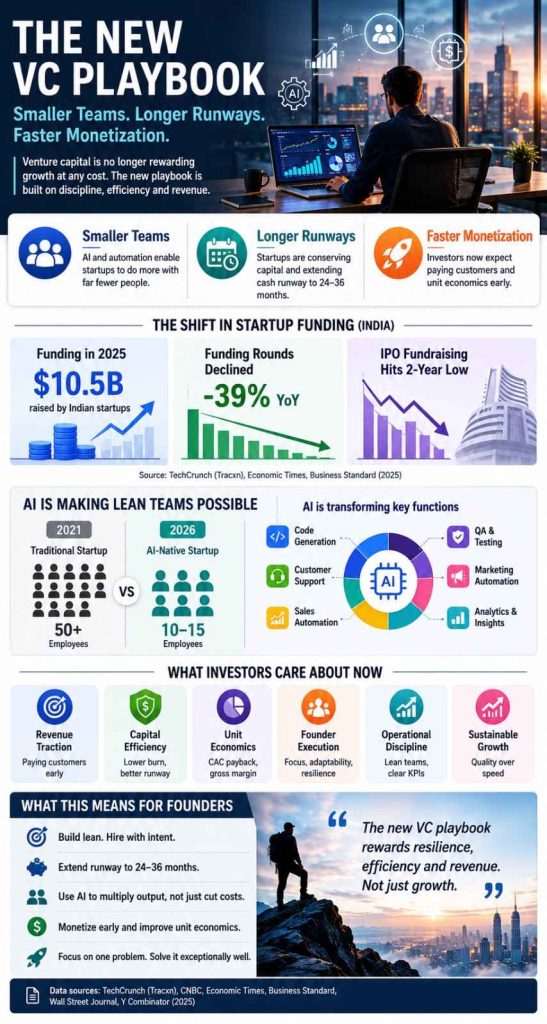
The transformation is especially visible in AI-native startups. Companies that once required large engineering teams can now launch products with fewer people using AI-assisted development tools. Venture firms increasingly view capital efficiency, revenue discipline, and operational focus as stronger indicators of long-term resilience than rapid headcount growth.
This new VC playbook is reshaping startup hiring, fundraising, product development, and even founder psychology.
The End of the “Growth-at-All-Costs” Era
The previous decade’s venture model was built around abundant liquidity and aggressive risk appetite. Cheap global capital allowed startups to prioritize user acquisition over profitability. Venture investors often encouraged founders to raise frequently and spend heavily to dominate markets.
That environment changed sharply after rising interest rates, weaker public tech valuations, and a global correction in venture markets.
In India, startup funding showed modest recovery in 2025, but investors remained significantly more selective. According to Tracxn data cited by TechCrunch, Indian startups raised roughly $10.5 billion in 2025, while the number of funding rounds fell nearly 39% year-on-year.
The message from investors became clearer across sectors:
- Growth alone is insufficient
- High burn rates are no longer tolerated
- Follow-on funding cannot be assumed
- Profitability timelines matter again
This shift has fundamentally changed founder behavior.
Instead of asking, “How fast can we grow?”, startups are increasingly asking:
- How long can our runway last?
- Can we reach break-even without another large round?
- Can AI replace expensive operational layers?
- Is revenue scaling alongside product adoption?
Why Smaller Teams Are Becoming the Default
One of the most important structural changes in venture-backed startups is team size.
Historically, startups treated headcount growth as a proxy for momentum. Large engineering teams, aggressive sales hiring, and expanded management layers were seen as signs of scale readiness.
Today, investors often interpret bloated teams as operational inefficiency.
AI Is Compressing Team Structures
Artificial intelligence tools are significantly reducing the manpower required to build and iterate software products.
Y Combinator CEO Garry Tan said in 2025 that roughly a quarter of YC startups had codebases that were “95% AI-generated.” He argued that founders no longer need teams of 50 or 100 engineers to build scalable products.
This is not merely about coding productivity. AI tools are increasingly handling:
- Customer support
- Sales prospecting
- QA testing
- Marketing automation
- Internal analytics
- Product documentation
The result is a new startup architecture centered around highly compressed teams.
The “AI-native pod” structure — small cross-functional groups supported by AI agents — is already appearing inside technology companies. A recent Wall Street Journal report described how firms are reorganizing around compact teams designed for faster execution and lower overheads.
Lean Teams Are More Fundable
Investors now increasingly associate lean teams with stronger operational discipline.
Smaller organizations typically offer:
- Lower monthly burn
- Faster decision-making
- Reduced managerial complexity
- Better capital efficiency
- Longer cash runways
This is especially important in an environment where late-stage funding remains uncertain and IPO markets are less predictable.
Runway Has Become a Core Valuation Metric
In the previous venture cycle, runway often mattered less because founders assumed capital would remain accessible.
That assumption no longer holds.
VC firms are now closely examining how long startups can survive without raising additional capital. Many investors prefer companies with 24–36 months of runway instead of the earlier norm of 12–18 months.
The logic is straightforward:
- Capital markets remain volatile
- Follow-on rounds take longer
- Down rounds remain a risk
- Exit timelines are extending
This has led startups to aggressively optimize operating expenses.
The Return of Financial Discipline
Indian SaaS startups, in particular, are recalibrating toward profitability and margin discipline. Industry reports indicate that founders are increasingly prioritizing predictable cash flows and lower burn over rapid expansion.
Several operational patterns are emerging:
Delayed Hiring
Founders are postponing non-essential recruitment and relying more heavily on contractors or AI tools.
Narrower Product Scope
Instead of building large platform ecosystems early, startups are focusing on one high-value workflow or vertical use case.
Conservative Geographic Expansion
Many startups are delaying international expansion until core markets become profitable.
Reduced Marketing Spend
Performance marketing budgets are facing closer scrutiny as CAC efficiency becomes central to investor conversations.
Faster Monetization Is Now Expected
Perhaps the biggest philosophical shift in venture capital is the growing emphasis on early monetization.
During the zero-interest-rate era, startups often prioritized engagement or user growth before developing meaningful revenue models. Freemium expansion and market capture dominated strategy.
That tolerance has weakened considerably.
Investors Want Revenue Proof Earlier
Early-stage founders are increasingly expected to demonstrate:
- Paying customers
- Revenue retention
- Gross margin quality
- CAC recovery timelines
- Expansion revenue potential
The benchmark for “traction” has changed.
Today, a startup with modest but real revenue may attract stronger investor interest than a high-growth company with weak monetization fundamentals.
Product-Led Growth Is Becoming More Important
In SaaS, especially, product-led growth (PLG) models are gaining favor because they reduce customer acquisition costs and improve scalability.
Industry analyses suggest that PLG has become the default go-to-market strategy for many Indian SaaS companies below $10 million ARR.
VCs increasingly prefer startups where:
- Users convert organically
- Distribution costs remain low
- Revenue scales efficiently
- Sales dependence is minimized
This aligns directly with the broader push toward lean operations.
How Venture Firms Themselves Are Changing
The reset is not limited to founders.
Venture firms themselves are adapting their investment strategies.
Higher Conviction, Fewer Bets
Instead of broad portfolio expansion, many firms are concentrating capital into fewer startups with stronger fundamentals.
Industry reports show venture capital deployment concentrating into larger, higher-conviction deals while overall deal counts decline.
VCs are increasingly prioritizing:
- Capital efficiency
- Founder execution capability
- Distribution strength
- Clear monetization pathways
- Sustainable unit economics
AI Is Changing Venture Math
AI has also altered assumptions around capital requirements.
If startups can build meaningful products with dramatically smaller teams, they may require less venture funding overall.
That creates a potential structural challenge for traditional VC models, which historically depended on deploying large amounts of capital into hyper-scaling businesses.
Some investors now believe the next generation of valuable startups could reach substantial revenue milestones with significantly smaller funding rounds than earlier unicorn-era companies required.
The Indian Startup Ecosystem Is Entering a Maturity Phase
India’s startup ecosystem is also showing signs of maturation.
Public market scrutiny, IPO expectations, and investor caution are collectively pushing startups toward more sustainable operating models.
A growing number of venture-backed Indian firms entering public markets have emphasized profitability and disciplined economics rather than aggressive expansion narratives.
This represents a broader cultural shift:
Earlier Era
- Hypergrowth
- Market capture
- Burn-heavy expansion
- Headcount signaling
- Valuation maximization
Emerging Era
- Operational efficiency
- Revenue quality
- Sustainable scaling
- Lean execution
- Profitability visibility
For founders, this changes both company-building strategy and fundraising storytelling.
The Risks of the Lean Startup Extremes
The new VC playbook is not without risks.
While leaner teams and faster monetization improve capital efficiency, excessive optimization can create problems.
Underinvestment in Innovation
Some startups may become overly cautious, limiting experimentation or long-term R&D investment.
AI Dependency Risks
Heavy reliance on AI-generated code and automation introduces concerns around software reliability, maintainability, and differentiation.
Even within founder communities, debates continue around whether AI-heavy development sacrifices technical robustness for speed.
Founder Burnout
Small teams operating under aggressive efficiency expectations may increase pressure on founders and early employees.
The risk is that startups become financially disciplined but strategically constrained.
What the Next Five Years Could Look Like
The venture ecosystem is unlikely to return fully to the excesses of the 2020–2021 funding cycle.
Instead, several long-term trends are beginning to solidify:
AI-Native Startups Will Stay Leaner
Many future startups may reach significant scale with fewer employees than earlier tech companies required.
Profitability Will Matter Earlier
Revenue quality and margin discipline are likely to remain core investor priorities.
Seed Funding Will Become More Competitive
As investors become more selective, startups may need stronger proof of monetization even at early stages.
Vertical SaaS and Specialized AI Could Benefit
Investors increasingly favor startups solving narrow, high-value business problems with clear monetization pathways.
Operational Efficiency Could Become a Durable Advantage
Capital efficiency may evolve from a temporary defensive strategy into a long-term competitive differentiator.
Conclusion
The venture capital industry is undergoing one of its most important philosophical resets in more than a decade.
The old startup formula — raise aggressively, hire rapidly, and monetize later — is giving way to a leaner, more disciplined model built around efficiency, revenue, and sustainability.
AI has accelerated this transition by enabling startups to achieve more with fewer people. At the same time, tighter capital markets and changing investor expectations have forced founders to rethink how companies should scale.
The result is a new VC playbook defined by:
- Smaller teams
- Longer runways
- Faster monetization
- Operational discipline
- Sustainable growth
For founders, the shift may initially feel restrictive compared to the free-spending era of venture capital. But it may also produce healthier companies — businesses capable of surviving beyond funding cycles and market hype.
In many ways, venture capital is rediscovering something the startup ecosystem temporarily forgot: great companies are not built only on growth. They are built on resilience.
Also Read : Indian Startup Media Is Changing — and Founder PR Strategies Are Changing With It
Add Startup Chronicle as a preferred source on Google- Click Here
Last Updated on Monday, May 25, 2026 8:51 am by Startup Chronicle Team
About The Author