India’s fast-growing home services market is attracting fresh investor attention, and home salon startup Yes Madam is the latest beneficiary.
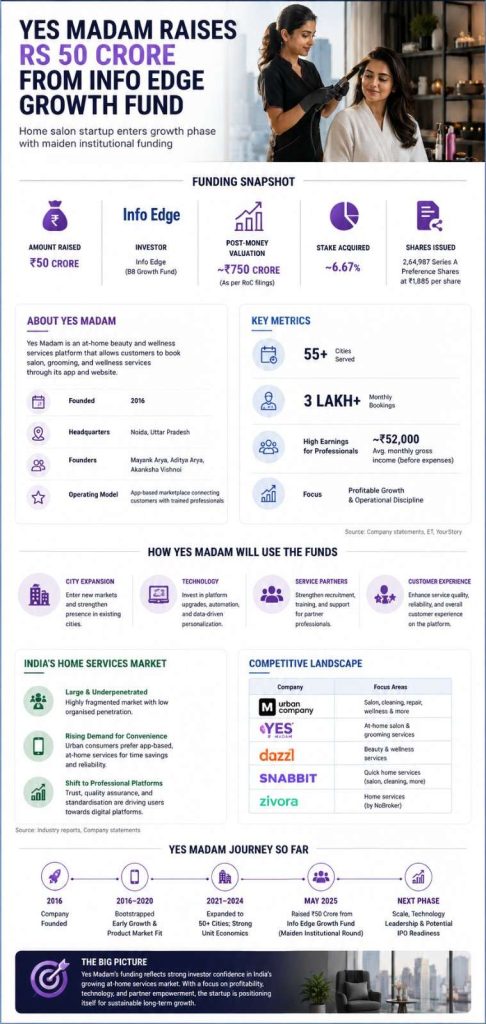
The Noida-based startup has raised Rs 50 crore in its first institutional funding round from Info Edge through its B8 Growth Fund, marking a significant milestone for a company that has operated largely bootstrapped since its founding in 2016.
The funding comes at a time when India’s on-demand home services sector is witnessing renewed competition, particularly in beauty, wellness, and rapid home-service delivery categories. Investors are increasingly betting that convenience-led consumer behaviour — accelerated by urban lifestyles and app-based service adoption — can create large scalable businesses beyond food delivery and ecommerce.
For Yes Madam, the capital infusion is less about survival and more about structured expansion.
A Decade-Long Bootstrap Journey Reaches an Inflection Point
Founded by Mayank Arya, Aditya Arya, and Akanksha Vishnoi, Yes Madam built its business without institutional capital for nearly a decade. The company currently operates across more than 55 cities and processes over 3 lakh bookings every month, according to company statements cited in multiple reports.
The platform connects users with trained professionals for at-home beauty and wellness services, including haircuts, facials, waxing, massages, and grooming treatments.
Unlike many venture-backed consumer startups that prioritised growth over unit economics during the past decade, Yes Madam has positioned itself as a profitability-focused company. The startup said it intends to continue maintaining operational discipline even as it scales.
According to filings referenced by ETStartup, the company issued 2,64,987 Series A preference shares at Rs 1,885 per share to raise the fresh capital, valuing the business at around Rs 750 crore post-money.
Info Edge has reportedly acquired roughly 6.67% stake in the company through the transaction.
Why Info Edge’s Investment Matters
Info Edge’s investment carries significance beyond the cheque size.
The company, best known for operating platforms such as Naukri.com and backing startups including Zomato and Policybazaar, has historically built a reputation for identifying scalable internet businesses early.
Its B8 Growth Fund has been actively looking at companies with strong fundamentals, efficient growth models, and category leadership potential. Yes Madam appears to fit that profile: a consumer internet business operating in a fragmented market with relatively low organised penetration.
In comments reported by Moneycontrol, Info Edge Growth Fund partner Amit Behl highlighted the startup’s capital efficiency and operational discipline as major differentiators.
The investment also signals growing institutional confidence in India’s professionalised home-services ecosystem, which is evolving from an unorganised sector into a technology-enabled consumer category.
India’s At-Home Services Market Is Becoming More Competitive
The funding arrives amid intensifying competition in the broader home-services segment.
Market leader Urban Company continues to dominate categories such as salon-at-home, appliance repair, cleaning, and wellness. At the same time, several startups are experimenting with faster delivery models and verticalised services.
Recent entrants and competitors mentioned across industry reports include Dazzl, Snabbit, and NoBroker’s Zivora.
The sector is benefiting from multiple structural shifts:
1. Convenience-Led Consumption
Urban consumers increasingly prefer app-based, at-home services that eliminate travel and waiting times. The behavioural change accelerated after the pandemic and has persisted even as offline salons recovered.
2. Standardisation and Trust
Historically, India’s beauty services market has been highly fragmented and informal. Startups such as Yes Madam are attempting to solve for reliability, hygiene standards, transparent pricing, and service consistency.
3. Female Workforce Participation
Platforms offering flexible work opportunities for beauticians and service professionals have also gained traction by enabling income generation outside traditional salon employment structures.
Yes Madam claims that professionals on its platform earn average monthly gross income of around Rs 52,000 before expenses.
However, the company’s model also reflects broader operational challenges within gig-enabled services businesses.
The Supply Challenge in Home Beauty Services
While customer acquisition often receives investor attention, supply creation remains one of the biggest operational bottlenecks in the category.
According to statements made by CEO Aditya Arya, onboarding and training service partners at scale remains difficult because professionals are required to invest in kits and maintain service quality standards.
This highlights a less-discussed reality in India’s gig economy: service marketplaces are only as strong as their supply quality.
Unlike food delivery, where fulfilment depends primarily on logistics, beauty and wellness services depend heavily on skill consistency, customer trust, and repeat engagement. Poor service experiences can directly impact retention and brand credibility.
As competition intensifies, platforms that can build durable partner ecosystems may gain a stronger long-term advantage than those relying purely on discount-led customer acquisition.
What the Funding Will Be Used For
Yes Madam said the fresh capital will be deployed across four major areas:
- Expansion into additional cities
- Technology investments
- Strengthening its service partner ecosystem
- Enhancing customer experience
Technology investments are likely to become increasingly important as home-services startups compete on discovery, scheduling efficiency, repeat bookings, AI-driven recommendations, and workforce management.
The company has also indicated interest in strengthening governance frameworks as it looks toward long-term scaling and potential IPO readiness.
That positioning is notable because Indian public markets have become more receptive to technology-led consumer companies that can demonstrate profitability discipline alongside growth.
Can the Home Services Category Produce Large Outcomes?
The bigger question investors are asking is whether India’s home-services sector can generate durable, large-scale outcomes comparable to food delivery or ecommerce.
The category remains structurally difficult:
- Service quality varies across geographies
- Customer retention can be inconsistent
- Supply management is operationally intensive
- Unit economics can weaken with aggressive expansion
Yet the opportunity remains significant because India’s beauty and wellness market itself is large and still underpenetrated in organised digital formats.
Consumer expectations are also changing. Increasingly, urban households are willing to pay premiums for convenience, verified professionals, predictable service quality, and time savings.
This is particularly relevant in metro cities where dual-income households and time-constrained professionals are driving demand for on-demand home services.
If startups can combine strong operational execution with sustainable economics, the category could evolve into a meaningful segment within India’s broader consumer internet ecosystem.
The Road Ahead for Yes Madam
For Yes Madam, the latest funding round represents both validation and pressure.
The company now enters a phase where investors will expect structured scaling, stronger governance, deeper technology integration, and defensible market positioning against larger and better-funded rivals.
Its biggest strengths currently appear to be:
- Early profitability focus
- Operational discipline
- Multi-city presence
- Established partner network
- Brand familiarity in the home beauty segment
However, maintaining service quality while scaling rapidly across cities will likely determine whether the company can evolve from a regional success story into a nationally dominant consumer platform.
The next few years could also reveal whether India’s home-services market rewards scale alone — or operational depth.
Also Read : The New VC Playbook: Smaller Teams, Longer Runways, Faster Monetization
Add Startup Chronicle as a preferred source on Google- Click Here
Last Updated on Tuesday, May 26, 2026 5:46 am by Startup Chronicle Team
About The Author
